Key takeaways
- Naturalisation is how an adult becomes a British citizen after settling in the UK; it applies once you already hold ILR or settled status.
- Most applicants need 5 years of lawful residence and must have held ILR or settled status for at least 12 months. Spouses and civil partners of British citizens need 3 years and no 12-month wait.
- You must not have spent more than 450 days outside the UK in the 5-year period (270 days in the 3-year spouse route), or more than 90 days outside the UK in the final 12 months.
- You must pass the Life in the UK test, meet the English language requirement, and satisfy the good character requirement.
- Since 10 February 2025, an applicant who entered the UK illegally or arrived on a dangerous journey will normally be refused on good character grounds, regardless of how much time has passed.
- The current Home Office fee is £1,709 to apply plus a £130 citizenship ceremony fee — £1,839 in total. A decision usually takes up to 6 months.
Naturalisation is the main way an adult foreign national becomes a British citizen. If you hold indefinite leave to remain (ILR) or settled status and have lived lawfully in the United Kingdom for long enough, you can apply to the Home Office to be “naturalised” and hold the same rights as any other British citizen.
Table of contents
- What is naturalisation?
- Who is eligible for naturalisation?
- Naturalisation as the spouse of a British citizen
- Naturalisation in all other cases
- What are the residence requirements?
- The good character requirement
- Do you need to be of sound mind?
- Knowledge of English and the Life in the UK test
- Can you apply for citizenship after ILR?
- What does British citizenship give you?
- How much does naturalisation cost?
- How long does naturalisation take?
- Can you travel before you get a decision?
- How Sterling Law can help
- Why choose Sterling Law?
- FAQ
What is naturalisation?
Naturalisation is the legal process by which an adult who was not born British acquires British citizenship. It is granted by the Home Office under the British Nationality Act 1981 once you meet the residence, language, knowledge and good character conditions.
Naturalisation and citizenship are not quite the same thing: citizenship is the status you end up with, and naturalisation is the route an adult migrant takes to reach it. Children usually acquire citizenship through registration rather than naturalisation, and some people are British automatically by birth or descent. For a settled adult, naturalisation is almost always the correct route.
Once you are naturalised you become a British citizen for life. You can apply for a British passport, live and work in the UK without immigration restrictions, and vote in UK elections.
Who is eligible for naturalisation?
You can apply to naturalise if you are aged 18 or over, are of sound mind, intend to keep the UK as your main home, and meet the residence, absence, language, Life in the UK and good character requirements. The exact residence rules depend on whether you are married to, or in a civil partnership with, a British citizen.
There are two main routes: the standard 5-year route for most settled migrants, and the 3-year route for spouses and civil partners of British citizens. Both are set out below.
Naturalisation as the spouse of a British citizen
If you are married to, or in a civil partnership with, a British citizen, you can apply after 3 years of continuous residence in the UK. To qualify you must:
- be aged 18 or over;
- be married to, or in a civil partnership with, a British citizen on the date you apply;
- be of sound mind;
- meet the English language requirement;
- have passed the Life in the UK test;
- be of good character; and
- already hold indefinite leave to remain or settled status (there is no requirement to have held it for 12 months on this route).
You must have been resident in the UK, the Channel Islands or the Isle of Man throughout the 3 years before the date the Home Office receives your application. Over those 3 years you must not have spent more than 270 days outside the UK, and no more than 90 days outside the UK in the final 12 months.
You can read more about the spouse route on our page covering British citizenship by marriage.
Naturalisation in all other cases
If you are not married to a British citizen, you apply on the standard 5-year route. To qualify you must:
- be aged 18 or over;
- be of sound mind;
- meet the English language requirement;
- have passed the Life in the UK test;
- be of good character; and
- have held indefinite leave to remain or settled status for at least 12 months before you apply.
You must have lived in the UK for the 5 years before the date the Home Office receives your application. Over those 5 years you must not have spent more than 450 days outside the UK, and no more than 90 days outside the UK in the final 12 months.
What are the residence requirements?
The residence requirement is the condition that most often trips applicants up, because it combines a qualifying period with strict limits on time spent abroad. The two routes compare as follows:
|
Requirement |
Spouse of a British citizen |
All other applicants |
|---|---|---|
| Qualifying period in the UK | 3 years | 5 years |
| Maximum total absence in the period | 270 days | 450 days |
| Maximum absence in the final 12 months | 90 days | 90 days |
| Time you must have held ILR / settled status | None (must simply hold it) | At least 12 months |
You must also have been physically in the UK on the day exactly 3 or 5 years before the Home Office receives your application. The Home Office can exercise discretion where absences are slightly over the limit, but this is never guaranteed, so it is worth checking your travel history carefully before you apply. If you are still working towards settlement, see our guidance on indefinite leave to remain.
The good character requirement
You must show that you are of good character. There is no single legal definition, but the Home Office assesses your immigration history, criminal record, financial conduct (including tax and bankruptcy), honesty in previous dealings with the authorities, and any behaviour that would make citizenship undesirable.
Since 10 February 2025 the rules on good character have become significantly stricter. A person who applies for citizenship on or after that date and who previously entered the UK illegally will normally be refused, regardless of how long ago the entry took place. The same normally applies to anyone who arrived without the required valid entry clearance or electronic travel authorisation after making a dangerous journey, such as crossing the Channel in a small boat or travelling concealed in a vehicle. Arrival by commercial air travel is treated differently.
This is a major change: previously, an unlawful entry could often be overlooked once enough time had passed. Mitigating or exceptional circumstances can still be argued, but they are assessed narrowly, so early legal advice is essential if this may affect you. We explain the position, and the option to reapply, in our article on good character citizenship refusals and the 2026 policy.
Do you need to be of sound mind?
Yes. You must be of sound mind, meaning you can understand your decision to become a British citizen. Where there is a health condition that affects mental capacity, the Home Office may ask for medical evidence, and in limited cases the requirement can be waived so that a person is not excluded from citizenship because of a disability.
Knowledge of English and the Life in the UK test
You must prove your knowledge of English (or Welsh or Scottish Gaelic) and pass the Life in the UK test before you apply. Most applicants meet the English requirement with an approved B1-level speaking and listening qualification, a degree taught in English, or by being a national of a majority-English-speaking country.
The Life in the UK test is a 45-minute, 24-question multiple-choice test on British history, culture and law. You must pass it before submitting your application and include your unique reference number.
Can you apply for citizenship after ILR?
Yes. Naturalisation is the step after settlement, not a replacement for it. If you are on the standard route you can apply once you have held indefinite leave to remain or settled status for 12 months and meet the 5-year residence rule. If you are the spouse of a British citizen, you can apply as soon as you have ILR or settled status and meet the 3-year rule — there is no 12-month wait.
What does British citizenship give you?
Once you are naturalised you hold British citizenship for life. You can apply for a British passport, enter and remain in the UK free of immigration control, work and study without restriction, and vote and stand in UK elections. British citizenship also lets you pass citizenship to children born abroad in many cases, and the UK permits dual nationality, so you do not have to give up your existing citizenship unless your home country requires it.
How much does naturalisation cost?
The main cost is the Home Office application fee, plus the citizenship ceremony fee that becomes payable once your application is approved.
|
Item |
Cost |
|---|---|
| Naturalisation application (Form AN) | £1,709 |
| Citizenship ceremony | £130 |
| Total Home Office fee | £1,839 |
| Biometric enrolment | Included (no separate fee) |
| Life in the UK test | £50 per attempt |
| English language test (if required) | Around £150, depending on provider |
How long does naturalisation take?
The Home Office aims to decide most naturalisation applications within 6 months, and many straightforward cases are decided sooner. Complex applications — for example where there are long absences, a criminal record, or questions about identity or good character — can take longer.
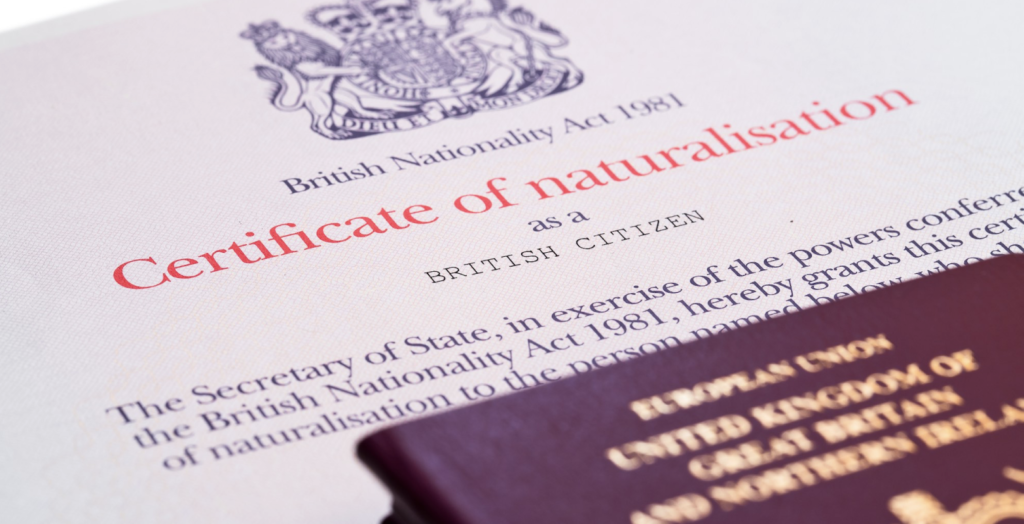
After your application is approved you are invited to a citizenship ceremony, which you must attend within 3 months of the invitation. You become a British citizen at the ceremony, when you make an oath or affirmation and receive your certificate of naturalisation. You can then apply for a British passport.
Can you travel before you get a decision?
Yes. You can travel while your application is being considered, but plan carefully. Your absences still count towards the residence limits, and you should keep evidence of any trips. If the Home Office is holding your documents, you can usually ask for them back for essential travel, and you must hold valid leave (such as ILR) to re-enter the UK. Leaving before a decision does not automatically harm your application, but a long or poorly timed absence can.
How Sterling Law can help
Most naturalisation refusals come from avoidable problems: miscounted absences, an overlooked good character issue, weak evidence, or applying at the wrong time. Our immigration team removes that risk by handling the application end to end.
We assess your eligibility and confirm the right route and timing; audit your travel history against the absence limits; review your immigration and character history and advise on any good character risk before you apply, including the post-2025 rules; check your Life in the UK and English evidence; prepare and submit Form AN with a complete document bundle; and deal with any Home Office queries through to your citizenship ceremony.
Why choose Sterling Law?
Sterling Law is a firm of solicitors regulated by the Solicitors Regulation Authority, with a large, multilingual immigration and nationality team advising individuals and families across the UK and abroad.
Our work can include:
- assessing your eligibility to naturalise and confirming the correct route;
- auditing your absences against the 3-year or 5-year limits;
- advising on good character concerns, including the rules in force since 2025;
- preparing and submitting your Form AN application;
- assembling a complete supporting document bundle;
- advising spouses and civil partners of British citizens on the 3-year route;
- helping with the Life in the UK test and the English language requirement;
- responding to Home Office requests for further information;
- reviewing and rescuing applications that have stalled or been refused;
- advising on dual nationality and citizenship for your children;
If you are ready to naturalise, or simply want to check whether you qualify, our solicitors can review your position before you commit to the fee. Get in touch to arrange a consultation.
Frequently asked questions
What is naturalisation?
Naturalisation is the legal process by which an adult who was not born British becomes a British citizen after settling in the UK, granted by the Home Office once the residence, language, knowledge and good character conditions are met.
Is naturalisation the same as citizenship?
No. Citizenship is the status you hold, and naturalisation is the route an adult migrant takes to acquire it. Children usually become citizens by registration, and some people are British automatically by birth or descent.
How long do I have to live in the UK to naturalise?
Five years for most applicants, or three years if you are married to or in a civil partnership with a British citizen.
How many days can I be outside the UK?
No more than 450 days over the 5-year period (270 days over the 3-year spouse route), and no more than 90 days in the final 12 months.
Do I need ILR before I naturalise?
Yes. You must already hold indefinite leave to remain or settled status. On the standard route you must have held it for at least 12 months; on the spouse route there is no 12-month wait.
How much does it cost to naturalise in 2026?
£1,709 to apply plus a £130 citizenship ceremony fee, giving a total Home Office cost of £1,839, in addition to the £50 Life in the UK test.
How long does a naturalisation application take?
The Home Office usually decides within 6 months, though complex cases can take longer.
Can illegal entry affect my application?
Yes. Since 10 February 2025, an applicant who entered the UK illegally or arrived on a dangerous journey will normally be refused on good character grounds, regardless of how much time has passed.
Can I hold dual nationality?
Yes. The UK allows dual citizenship, so you do not have to give up your existing nationality unless your home country requires it.